






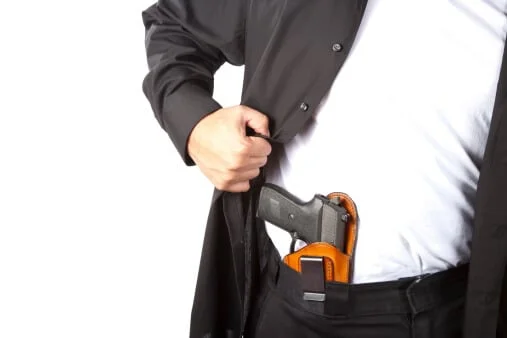
The people have the right to keep and bear arms for security, defense, hunting, recreation or any other lawful purpose.
-Wisconsin State Constitution, Article 1, § 25
The federal gun-rights landscape has moved twice in the last four years, and both moves reshape how we defend Wisconsin gun charges. New York State Rifle & Pistol Association v. Bruen (2022) rewrote the legal test for every Second Amendment challenge in the country. United States v. Rahimi (2024) then answered the first major question Bruen left open: what happens to that test when the government has a real safety interest at stake. Here is what changed, and what it means if you are facing a Wisconsin firearms charge.
Bruen Changed the Test, Not Just the Outcome
Before 2022, most federal courts analyzed gun laws with a two-step “means-end scrutiny” test borrowed from other constitutional areas: does the law burden Second Amendment conduct, and if so, is the burden justified by the government’s interest. In New York State Rifle & Pistol Association, Inc. v. Bruen, 597 U.S. 1 (2022), the U.S. Supreme Court threw that framework out. The new test asks only whether the government can show the challenged regulation is consistent with the nation’s historical tradition of firearm regulation. If the conduct falls within the Second Amendment’s plain text, the law is presumptively unconstitutional unless the government can point to a comparable historical analogue.
That single change reopened almost every settled gun-law challenge in the country, including federal prohibitions that hadn’t been seriously contested in decades, most notably the federal ban on firearm possession by people under domestic-violence restraining orders.
Rahimi Answered the Question Bruen Left Open
United States v. Rahimi, 602 U.S. 680 (2024), tested Bruen’s historical-analogue framework against 18 U.S.C. § 922(g)(8), the federal law that bars firearm possession by someone subject to a domestic-violence restraining order that includes a finding of a credible threat to another person’s safety. In an 8-1 decision (Justice Thomas dissenting), the Court upheld the law. Writing for the majority, Chief Justice Roberts held that a law disarming someone found by a court to pose a credible threat to another person’s physical safety fits comfortably within the historical tradition of disarming dangerous individuals, even without a founding-era law that looks exactly like § 922(g)(8).
Rahimi matters for two reasons in our practice. First, it confirmed that Bruen’s historical test is not a categorical win for every gun-rights challenge; when the government’s interest is protecting an identified, at-risk person from a demonstrated threat, the analogue requirement is easier to satisfy than early post-Bruen defense filings assumed. Second, it gave lower courts, including Wisconsin’s, a working template for evaluating other status-based firearm disqualifications, which is exactly where most Wisconsin gun defense now happens.
The Charge We See Most: Felon-in-Possession Under § 941.29
§ 941.29, Wisconsin’s felon-in-possession statute, makes it a Class G felony to possess a firearm if you have been convicted of a felony in Wisconsin or elsewhere, found not guilty of a felony by reason of mental disease or defect, committed under certain mental-health orders, or subject to a domestic-abuse or harassment injunction that includes the required notice. Post-Bruen, defense challenges to felon-in-possession statutes nationwide argued that a categorical, lifetime ban on all prior felons, regardless of the underlying offense, has no clean historical analogue.
Rahimi narrowed that argument rather than killing it. Courts applying Rahimi have generally distinguished between disqualifications tied to a specific, individualized finding of dangerousness (which Rahimi upheld) and blanket disqualifications based on felony status alone (which remain more contested). For a Wisconsin § 941.29 case, that distinction is the live issue: whether the predicate offense and the facts underlying it support the kind of dangerousness finding Rahimi relied on, or whether the charge rests on felony status alone with no individualized showing. That is a case-by-case analysis, and it is one we brief early, because it can affect both the constitutional challenge and how a case gets charged in the first place.
One point worth correcting, because it is repeated widely and it frightens people for no reason: § 941.29(4m) set a mandatory minimum of three years’ confinement for certain repeat offenders, but it no longer applies. Wis. Stat. § 941.29(4m)(b) states plainly that “this subsection does not apply to sentences imposed after July 1, 2020.” Any sentence imposed today falls outside it. If you have read elsewhere that a Wisconsin felon-in-possession charge carries a three-year mandatory minimum, that information is out of date. (Verified against docs.legis.wisconsin.gov, 2026-08-16.)
What does still matter in every § 941.29 case we handle is the underlying validity of whatever conviction, order, or adjudication makes someone a “prohibited person” in the first place. If that predicate is vacated, expunged, or was never properly entered, the felon-in-possession charge can fall with it.
Wisconsin’s Current Concealed-Carry Framework
Wisconsin residents may openly carry firearms in most places without a permit, and Wisconsin issues concealed-carry licenses under § 175.60. The Department of Justice must issue a license to any applicant who is not disqualified under the statute and who completes the application process, including a background check. Wisconsin also recognizes out-of-state concealed-carry licenses from states listed under the department’s reciprocity rule. Someone disqualified under § 175.60(3), the same population largely overlapping with § 941.29’s prohibited-person categories, cannot lawfully obtain a license, and carrying without one where a license is required, or carrying while disqualified, is its own charge separate from any underlying firearm-possession offense.
What a Wisconsin Gun Charge Defense Actually Looks Like Now
Every gun case we take on post-Rahimi starts with the same questions:
- Is the predicate disqualification valid, current, and properly documented? A felony conviction that was later vacated, an expired injunction, or a mental-health order that was never properly entered can undercut the entire charge.
- Does the underlying record support an individualized dangerousness finding, or is the state relying on status alone? This is the Rahimi distinction, and it is the sharpest tool available in a post-Bruen challenge to a Wisconsin firearms statute.
- Was the firearm actually possessed, in the legal sense? Constructive possession, shared residences, and vehicle-passenger cases are where a large share of Wisconsin § 941.29 charges are actually won or lost, independent of any constitutional argument.
- Is anyone still citing the § 941.29(4m) mandatory minimum at you? They should not be. By its own terms at § 941.29(4m)(b) it does not apply to sentences imposed after July 1, 2020. Penalties come from the Class G felony classification instead, which carries a maximum rather than a floor.
The Bottom Line
Wisconsin remains a state with a strong constitutional gun-rights tradition and comparatively few state-level restrictions beyond the CCW licensing framework and the standard federal and state prohibited-person categories. What changed is the constitutional battlefield those categories now sit on. Bruen forced every gun-possession disqualification to justify itself against historical tradition. Rahimi showed that individualized dangerousness findings survive that test, while status-based, one-size-fits-all disqualifications remain the more vulnerable target. If you are facing a Wisconsin firearms charge, that distinction should be the first thing your attorney evaluates.
If you are facing a gun or weapons charge in Racine, Kenosha, or Walworth County, contact us for a free consultation. We have defended Wisconsin firearms cases continuously since 1994.
Sources
- New York State Rifle & Pistol Association, Inc. v. Bruen, 597 U.S. 1 (2022)
- United States v. Rahimi, 602 U.S. 680 (2024)
- § 941.29, Wisconsin Statutes (possession of a firearm)
- § 175.60, Wisconsin Statutes (license to carry a concealed weapon)